Showing posts with label Catalan food. Show all posts

Sunday, 27 April 2014

Catalan Style Broad Beans


The spring vegetables are here, broad beans, peas, spring onions and fresh garlic.  The cherries are starting to turn pink and the birds are starting to gather around ,it won't be long before we hear the melodious song of the Golden Oriole, a lover of cherries.  The Hoopoe, Bee Eater and Swallow have already arrived and are busy nest building, spring is finally here..
 
I'm having a good crop of broad beans this year but I have had to spend quite a bit of time wiping the black fly off the pods and leaves.  The ants, well they are always present in my veg garden.  Luckily for me that the garden is full of ladybirds, so help is at hand.
 
This dish of broad beans is served as a tapa in bars but can also be served as a starter but I must warn you that it is very rich in flavour.  I have included white pudding, not easily available outside of Spain, so this can be omitted but the black pudding cannot as it is an integral part of this lovely dish.  A trip down the butchers to buy the meat and at the same time I picked up a few tips. I was told some people add a small glass of white wine, some add a glass of sweet muscatel wine and some a splash of anise based alcohol. The choice is yours to experiment. 
 
Serves 4 as a starter
 
Ingredients
 
1 kg of fresh, tender broad beans, shucked weight
2 spring onions, the large type
2 fresh garlic cloves
200 g pork belly
150 g black pudding
150 g white pudding, optional
100 g Serrano ham or pancetta
1 bay leaf
2 ripe tomatoes
sprig of mint
large pinch of aniseed
Olive oil
Salt and Pepper


How to go about it

Prepare the meat, cut the pork belly and ham or pancetta into strips.  Slice the puddings into half moon slices.  Finely chop the onions and garlic.  In a frying pan heat some olive oïl and add the pork and ham and gentle fry until they start to give their fat, add the onions, garlic,bay leaf and anise.  Gentle cook this until the onion is transparent.  Cut the tomatoes in half and grate the tomato over the pan leaving behind the skins, let this cook gentle for about 10 minutes.  Add the broad beans, season with salt and pepper and cook for 10 minutes, moving the beans constantly.  Lastly add the black and white pudding and the few leaves of torn mint, cook for 5 more minutes.


Wednesday, 26 February 2014

Almond Biscotti


I was unsure whether to use their Italian, Spanish or Catalan name when giving this post its title but in the end I chose the name by which they are known in England - Biscotti.  They are called Cantucci or Cantuccini in Italy, Carquinyoles and Carquinyolis in Spain and Catalonia.

The almond plays an important part in the cuisine of all the Mediterranean countries, you'll find it equally in savoury and sweet recipes, rich in vegetable protein and calcium it is an ideal food for anyone looking to improve their diet.

My recipe contains aniseed, mildly addictive for horses and humans.  I spent my youth trying to catch difficult ponies walking for hours in ever decreasing circles in the hope of catching some cunning New Forest pony who would outwit me every time. Until someone told me that a bit of anise oil on a sugar lump will turn you into the equivalent of the pied piper for horses.  I  suspect it is the same for people.  When I offer these to house guest, I watch them returning to the biscuit jar all day long, one is never enough.

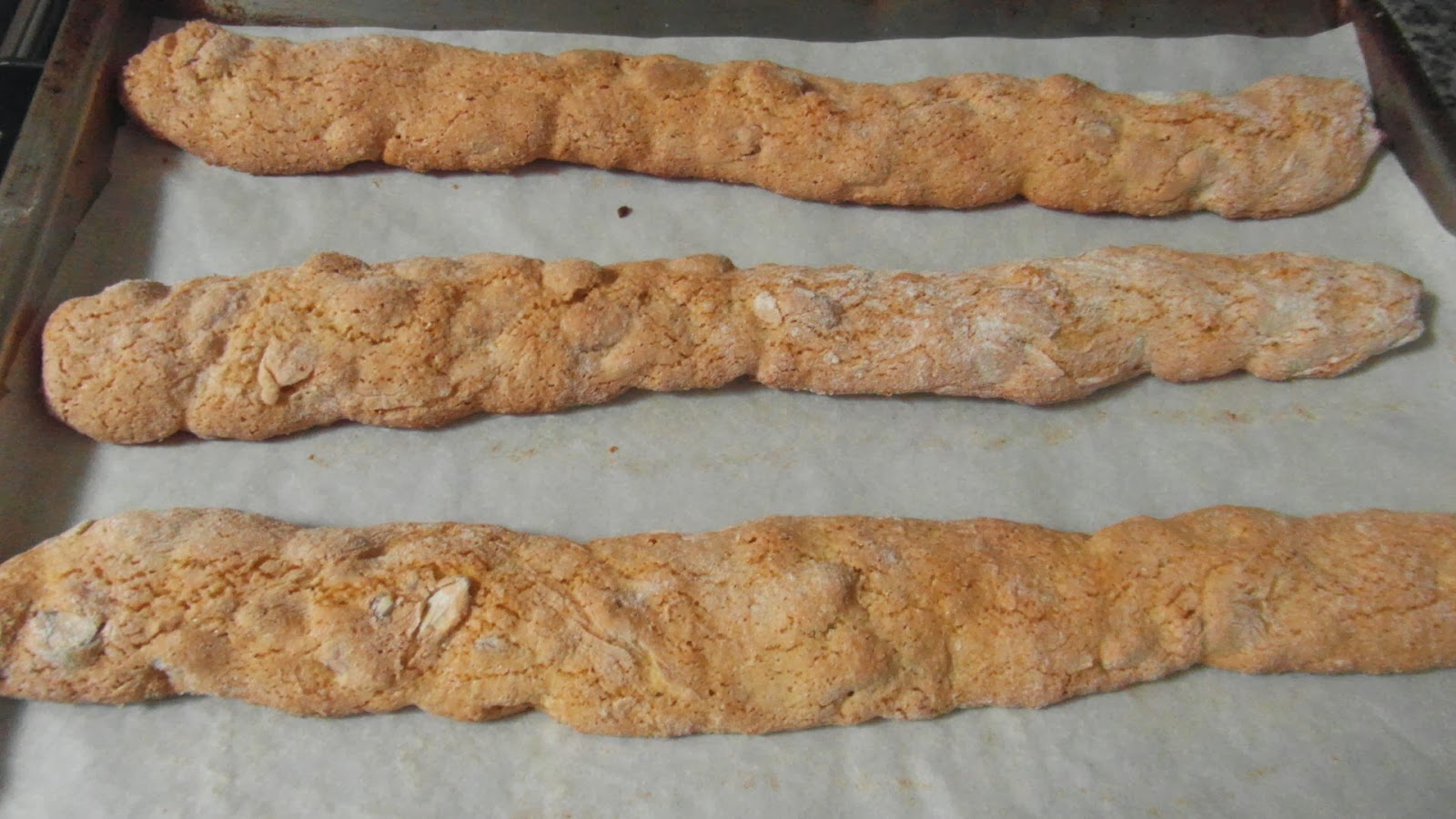
The secret to making a biscotti (means twice cooked in Italian) is to cook them so they rise a little and are cooked but still pale on the first cooking.  Then they are cut and cooked again in order to dry them out.  So you end up with a biscuit that is hard and dry but melts in the mouth.  You don't want to break your teeth!  I always make a large batch as they keep for months in a jar.

Ingredients

500 g plain flour
350 g sugar
1 teaspoon baking powder
1 tablespoon vanilla sugar
2 teaspoons aniseed's
250 g whole, unpeeled almonds
5 large eggs

How to go about it

Preheat the oven 180°c.  Prepare 2 large baking trays and put baking paper on each one.  In a bowl mix flour, sugar, baking powder, vanilla sugar, aniseed and almonds, mix all together.  Lightly beat the eggs in another bowl and add to the flour bowl until you have a sticky dough, you might not need all of the eggs.  It will be sticky.  Turn out onto floured work surface, have extra flour available if needed. Divide into 6 equal parts.  If you like you could weigh it and divide by 6 to make it more equal.  Roll each amount into a long sausage shape and place 3 on each tray.  Bake trays separately if your oven doesn't bake evenly for 25 minutes a time, keep an eye on them as they can burn easily, especially underneath.  They should be light golden.  Roll off of the tray and paper and cut diagonally.  Put paper back on the tray and place cut biscotti, cut side down on paper.  When they have all had the first cooking reduce the oven to 100°c and then put both trays back in the oven and bake for 1h30.  Turn off oven and leave them in the oven overnight, with out opening the door.  Next day put them in a jar or other airtight container.


Monday, 24 February 2014

Clotxa

I always say that it is the winters that make it worth while to live in the Mediterranean and not the summers. It is nearly always sunny and most days it is possible to eat outside. Here in Catalonia they like to take advantage of this and have many fiestas that involve eating.

Clotxa (pronounced clotcha) is a sandwich of the countryside.  It can be made with sausages or other vegetables but traditionally it is made with salted preserved sardines, tomatoes and onions. It was made famous by a village called Riba-Roja d'Ebre.  A village by the river Ebro in the south of Catalonia.  Many villages of this region are now having Clotxa fiestas.


Serves 2-4

Ingredients

1 round 1 kg loaf
4 tomatoes
4 small onions
4 salted sardines (you can use any salted fish, such as kippers or smoked eel)
Extra virgin olive oil


Prepare a BBQ or heat the oven to 230 c. If you are cooking in the oven you can wrap the tomatoes and onions in foil and place in the oven.  Pan fry the sardines for a few minutes on each side.


Wait until the flames have died down and you are left with the hot embers.  Place the tomatoes and onions (unpeeled) on the heat and cook for about 10 -15 minutes, turning to cook all sides.  Place the sardines on the BBQ  and cook for a minute on each side.  While everything is cooking cut the loaf in half and carefully cut out the centers and reserve.  As soon as the everything is cooked and cool enough to handle peel the tomatoes and cut out the core and squash into the center of the halves, then peel the onions and do the same.  Skin the fish and take out the bones and add to the halves.  Drizzle in a good amount of olive oil into each half and then replace the bread in the center, squash down and cut into quarters if you like and eat.


Friday, 14 February 2014

Curly Endive Salad with Romesco Sauce


This salad is called Xato (pronounced chato) in Catalonia.  It is tradionally made with tuna, anchovies and raw salt cod, I have left out the salt cod for this recipe as it is not to everyone's taste.  Escarolas (curly endives) are now in season and you will see that a lot of villages in Catalonia having this traditional salad with competions for making the romesco sauce.

To make authentic Romesco sauce you really need Ñora or Choricero dried peppers, you can buy them from Spanish suppliers online.  If you make it without it will not be the same and in my mind it is worth to source them, they come dried on a string and can be hung up in the kitchen.  If you have a garden or greenhouse you could grow them.


Ñoras


Choricero

Serves 4

Ingredients

1 escarola (curly endive)
Small tin of anchovies in oil
Tin of tuna in oil
50g black olives in oil

For the Romesco sauce

2 tomatoes, cut in half
15 Almonds
15 Hazelnuts
slice of rustic bread
7 garlic cloves
75 ml extra virgin olive oil
2 Ñora or Choricero
Splash of red wine vinegar
salt

How to go about it

First put the dried peppers in a small bowl and cover with boiling water and leave for a few hours to soak. Wash the escarola, use only the really light green leaves, save the outer, darker green leaves and use in a soup if you wish.  Put the drained escarola in the fridge to crisp up.


The romesco can be made in the oven or in a frying pan.  Add a couple of tablespoons of olive oil to the pan and gentle fry the whole unpeeled garlic cloves, keeping one back to add raw.  If you prefer a milder flavour of garlic then cook all the cloves.  In the same pan fry a piece of bread and tomatoes.  Dry fry the nuts. Or you can roast the ingredients in the oven 160c for 20 minutes, roast the nuts for only 10 minutes and keep an eye on them as they burn easily.  You can make this in a pestle and mortar or use a hand liquidizer.  Scrap of the flesh from the peppers, skin and seed the tomatoes and mix with all the other ingredients add the vinegar at the end, just a teaspoon to lift the flavour a bit. Loosen the sauce with a splash of boiling water and toss the escarola in a bowl with the romesco,  you might not need all of the sauce, you can save it for another day.   Arrange on plates and top with anchovies, tuna and olives.


Catalan Bread with Tomato


I get pregnancy type cravings for Pan con Tomato or (Catalan spelling) Pa amb Tomàquet, it's a basic thing but taste divine.  You can eat it as it is or top it with Serrano ham or Manchego cheese for example.


Ingredients

Tomatoes
Country style bread
Garlic
Extra virgin olive oil,  Arbequina if you can get it
Manchego cheese
Jamon Serrano


There are two ways of making it. The traditional way is to rub a cut tomato onto bread or toast.  You usually use a special tomato for this method which is called a hanging tomato.  These tomatoes are dried on the vine in a dry place for winter.  They have a particularly thick skin which makes them ideal for this preserving method.  The odd one goes rotten but more or less they will keep for months in this way.


Hanging Tomatoes


Bread rubbed with hanging tomatoes

The modern way of making tomato bread is to grate the tomato into a bowl add olive oil and salt and then spread it onto the bread or toast.


You can rub garlic onto the bread first, this is better suited to toast as the hard crust makes it a natural grater.


Then rub or spread tomato onto the bread.  If you rub the tomato onto the bread, drizzle olive oil onto it afterwards.  Sprinkle with sea salt and top with your chosen topping.